Showing posts with label central government. Show all posts

Jul 20, 2011

Closeup on Kawerau (pt 2)


I know my last post on Kawerau lacked proper structure; unfortunately today’s post does as well. Over the past twenty four hours I’ve been collecting a number of disparate thoughts and committing them to two posts. I haven’t had the time to refine my thoughts and place those thoughts in a logical structure. Hopefully you don’t get lost in this post.

Today I’ll refrain from commenting on the quality of Closeup’s follow-up story on Kawerau. I’ll focus on the issues. On a positive note, the story did identify one of the causes of dysfunction in Kawerau and, thankfully, one of the solutions. It doesn’t take a genius to discover that joblessness is one of the drivers of dysfunction in Kawerau and that jobs are one of the solutions.

The unemployment rate in Kawerau stands at 19.3% compared with 7.5% nationally and 16.1% for Maori. This is unacceptable, but hardly surprising. The simple, simple fact is: there are not enough jobs in Kawerau. The most successful businesses in Kawerau are New World and the local pubs. The main industries, forestry and pulp and paper production, are high skill industries. Secondary industries, read those supporting the main industries, are also high skill, for example engineering, electrical work and heavy machinery work. Most Kawerau residents do not have the skills to even think of applying for those sorts of jobs. This is, in part, a failure on their part, but mostly a failure on the government’s part.

In Kawerau you move from a decile one primary school, to a decile one intermediate school and then onto a decile one high school. This is not a dig at the quality of low decile schools – my primary education was good – my point is that students attending low decile schools receive fewer opportunities than students attending higher decile schools. The teaching staff are, and this may be an unjustified claim, at the lower end of the scale while the resources available to the school, staff and students often fall below what you would expect in a developed country. Once students reach the third tier of schooling they are less likely to at the same level or ahead of their peers at other high schools. Now this is where it gets interesting in Kawerau. Kawerau College is shit.

Kawerau College is one of, if not the worst, high school in New Zealand. Former Principal Steve Hocking left a few years ago in disgrace after allegation emerged that he had smoked cannabis and sexually assaulted a student among other allegations. The achievement levels at the school are well below average, even against comparable schools. The teaching staff are, as is the case with poor performing schools, well under par with many holding primary school teaching qualifications only. The student body is captured in a culture of low expectation. Gang culture permeates the school and career aspirations are near non-existent. Kawerau College has a major role to play in improving Kawerau in terms of creating expectation and equipping students with life skills and job skills.

It is thoroughly normal, in Kawerau that is, to move from school to the dole. Welfare dependency is engrained. There is a culture of dependency, but that is not a reflection on the dependent, but a failure on the part of the state and a reflection on decades of poor government policy. People in Kawerau move from school to the dole because that is the only option. There is the option of higher education, but that option is usually not available given that most Kawerau residents are underachievers as a result of an economic system that selects against the poor, a poor education, low expectation and a culture that does not value education or success as we define it.

One way to improve dysfunction in Kawerau is to create a culture that values success. Which brings me to another point, success in Kawerau needs to be redefined. Success is not a gang patch, success should not be defined by the your spotting prowess, success should be defined by the way you treat others, whether you achieve your goals and lead your life according to an acceptable value system.

Paula Bennett appeared on the show as well. Bennett expressed concern for Kawerau and indicated her willingness to improve the situation. The problem is, she has no solutions and is unwilling to acknowledge the true extent of the problem. I was lucky enough to sit on a meeting she had with community leaders in April. Bennett appeared responsive, however she had no idea how to tackle the problems and the advice and information she received at the meeting from community leaders seemed to fly right over her head.

Paula Bennett is of the view that the community has the power to change their situation. This is true, but to a limited extent. The community can effect a culture change and provide better support for the vulnerable, but the community cannot create jobs where economic opportunities are scarce. The community cannot fund vital services. Nor can Iwi either. It is not the place of Iwi to provide social services – government cannot expect to devolve their responsibilities.

The government needs to provide a hand-up. At the moment the government is merely, and I hate invoking this language, providing a hand-out. Chucking money at a problem hoping it will correct itself. Kawerau cannot auto-correct. The government needs to step in, in partnership with the community of course, and provide direction and support. A Commissioner needs to be placed in Kawerau College, the College Board needs to be sacked (they are incompetent), social services need to be overhauled and centralised for maximum effect, policy needs to be directed at under 5’s and youth, service providers need to focus on upskilling beneficiaries and ensuring they are work-ready, the government needs to invest in the local economy to create jobs and encourage the private sector to invest in the local economy. The Council needs to encourage growth through rates incentives and partnerships with Iwi.

These suggestions are just the beginning. More can be done and must be done. And it’s not up to the community to do it alone – they can’t. This is the place of government, this is the responsibility of government. Doing nothing is a cop out.

Feb 20, 2011

RWC Protest: A few thoughts


From today’s Sunday Star Times;

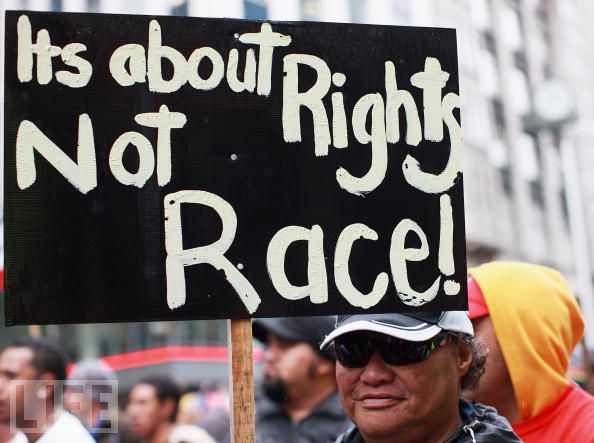
DISGRUNTLED Maori have warned that Rugby World Cup celebrations could be disrupted if their grievances – including those over the foreshore and seabed – aren't addressed.

I believe this is a tangible threat. Maori are beginning to grow impatient, certainly the younger generations are frustrated with the pace of change. The older generations are willing to accept, and are indeed accustomed to, sluggish progress, whereas young Maori are accustomed to a world that moves fast, a world where change is rapid.

The government would be wise to treat this threat as genuine. It would be incredibly reckless to disregard this as mumbo jumbo coming from the mouths of a few disaffected brown people. The possibility of mass protest is very real. The protest organisers will, I imagine, have little trouble mobilising thousands of protestors given the high unemployment environment, likely welfare changes and passage of the MCA bill. As Maori households continue to struggle political awareness will increase. The challenge is to channel that awareness into mass political action which admittedly is easier said than done. It is worth keeping in mind though that for Maori households, and of course many non-Maori households, it is painful knowing that you struggle but not as a consequence of your own actions. It is painful knowing you struggle due to incompetent economic management and a failure, on the government’s part, to neutralise the worst effects of their economic policy, for example the rise in GST. In my opinion poverty and deprivation, i.e. the current economic conditions, should be enough to amplify political awareness and facilitate political change.

Maori have identified an opportunity to push the government hard and they have a powerful weapon – leverage. Protest action, or the threat of, will deter more than a few overseas spectators. The government literally cannot afford to let this happen. The government looks to the RWC in the hope that it will stimulate the economy and help kick start growth. A significant decrease in spectator numbers will have a profound negative effect on the economy, after all the tournament is already forecast to make a loss. Therefore, it would be reckless for the government to disregard the threat of protest action.

The government also cannot afford to contain any protest. Given the authoritarian nature of the current government I can imagine the creation of “free speech zones”. Free speech zones are an undemocratic American creation used to contain protests. They are used to keep protestors out of the public eye, make them invisible. Of course such undemocratic behaviour would never be acceptable in New Zealand, or at least I hope it would never be acceptable, therefore the government would need to search for different means. How about kettling? This would be the worst response. There is no better way to turn a peaceful protest in to a riot. Maori respond in kind to physical confrontation. Without doubt things will turn very, very ugly. This would have the flow on effect of mobilising many more Maori. Violent clashes during such an international showpiece will do nothing for New Zealand’s reputation as a safe and stable tourist destination nor will it do anything for New Zealand’s standing in the international community.

Ultimately, for the sake of the economy and our international standing, the government cannot allow any protest during the RWC. Therefore, the protestors will have a significant amount of leverage.

However, the protestors should consider this. The international media are not going to pay any attention to an insignificant minority making some noise during an insignificant sporting tournament. The likes of the colonial Stephen Jones are not going to cover any story that is not related directly to what is happening on the rugby field. The international media present will be, by and large, sports journalist from Europe and covering political demonstrations in New Zealand will not be part of their brief or expertise.

There is also the threat of clashes between Maori and die hard rugby fans. Do Maori really want a repeat of the Springbok Tour? Is it really fair to divide the nation during what is meant to be a triumphant moment in New Zealand history? Is it not better to hold ones protest at the ballot box? Vote this scum government out?

Protest during the RWC will create anti-Maori feeling that will last a decade or more. Having said that equality and justice is more important than what others think of you. Sadly, New Zealanders fail to realise their own privilege, even if they did I am unsure they would have the courtesy to extend that privilege to the underprivileged. New Zealand is not an egalitarian country. We are a country divided, divided along class lines, divided according to ethnicity and divided along ideological lines. We are not equal, we are unequal. We are a country where the privileged are determined to preserve what they have over the rest of the country. Whether that be weakening work rights or failing to acknowledge the interests of the indigenous people. The privileged operate under the assumption that their rights are paramount and exclusive. Perhaps it will take mass political action during the RWC to effect change for the underprivileged, perhaps it will take mass political action during the RWC to win the rights that the privileged enjoy.

The government should not ignore the warnings. Maori will wreck the government’s precious tournament. All Maori ask for is equality.  

Feb 15, 2011

Local content

Yesterday I drove past a protest group calling for local jobs for local people, in particular tangata whenua. I do not want to go into the details of local exclusion from the job market I just want to say too often in Kawerau people identify the symptoms rather than the problems. Kawerau as a community needs to define the problem rather than look towards the symptoms. For example many people will cite unemployment as the problem when in reality it is merely a symptom of wider economic and social factors that are preventing business growth and upskilling respectively. What's more, the problem, or in most cases the symptoms, are more often than not examined in isolation. This leads to tunnel vision, a focus on limited range of solutions and outcomes.

If the Kawerau District Council and wider community do not do something to arrest the slide in social and economic indicators then the town is doomed. The current problems the town faces are a result of decades of trends that will take years to reverse. The council needs to stand up and take leadership on this issue. Show a little vision, a little bit of guts, take the risk. Unfortunately, I doubt this will happen. In my opinion the council lacks the vision, the expertise or even any awareness that they are presiding over a dying domain. If Kawerau cannot get its act together central government, and I am 100% sure of this, will force the district to amalgamate with Whakatane. And nobody wants that.