Jan 26, 2014

Winston’s comments overshadowed the real issues at Rātana

It’s a real shame that Winston Peters decided to launch his latest dog-whistle attack while waiting to be welcomed on to Rātana Pā on Friday. As was predictable, his comments became the major story of the day in the media, and they distracted from the very real kaupapa that were raised by the Rātana people themselves as politicians came to honour the birthday of the prophet Tahupotiki Wiremu Rātana. 

Te Temepara Tapu, Rātana Pā
For those who were lucky enough not to hear Winston’s comments, he essentially referred to the Māori Party’s policy gains in Government as “apartheid”. Supposedly, flying the Tino Rangatiratanga flag on Auckland Harbour Bridge, whānau ora, and separate Māori prison units are all apartheid policies. 

For Winston, this is all about electioneering. He is playing to his core constituency with these dog-whistle tactics. The desperate tone of his comments reveal a politician of a by-gone era trying to stay relevant. 

The comments were inappropriate given where he was speaking – one of T.W Rātana’s primary goals was the just restitution of Te Tiriti of Waitangi, a goal which he essentially disparaged with his attack on the Māori Party. They were also hugely inappropriate considering how recently Nelson Mandela passed away, a leader of the liberation movement that broke the stranglehold of real apartheid - a brutal, racist and completely inhumane regime. To compare that with the Māori Party's policies is extremely offensive.

I had the privilege of listening to and contributing to the kōrero on the paepae that day. We were informed by te iwi mōrehu (followers of the Rātana faith), of the realities of the day-to-day lives of their people. They implored political parties to work together for the benefit of the Māori people. Their key proposals were for a strong regional development strategy, investment in reducing youth unemployment, warm dry housing and an inclusive education system that equips tamariki and rangatahi with skills required for the jobs of the 21st Century. 

These are the issues that should have been debated in the media, and the issues political leaders should have been asked for comment on. But no, Winston’s strategy of grabbing the media attention with hyperbole worked for him – as it always does.

Kōtahitanga and the Labour-Green relationship 

The Labour and Green parties were welcomed on to the marae together – as has been the case for the last several years. Labour had a large delegation of MPs and candidates and the Greens were represented by co-leader Metiria Turei, Māori Green MPs Denise Roche and David Clendon, and candidates Marama Davidson and myself (Jack McDonald). 

Labour the Greens being welcomed on to Rātana
One thing that was very apparent was the health of the Lab-Green relationship; both parties work well together and are driven by many of the same core values, both are committed to raising the living standards of Māori, and working in collaboration for the benefit of all New Zealanders. 

Māori expect the parties of the Left to work together and embrace kōtahitanga. To honour Te Tiriti and eliminate poverty, we must change the government. Neither Labour nor the Greens can do that without the other. It's imperative that these parties look and act like a government-in-waiting, ready to get stuck in and work together so they can hit the ground running in the first 100 days of a new progressive government.

Of course the parties have their differences, some substantial, and the debate over risky deep sea oil drilling is a timely reminder of that. That is the nature of MMP and those differences can be thrashed out in post-election negotiations. 

At the end of the day, both Labour and the Greens need to listen to the teachings of T.W Rātana, who always stressed kōtahitanga and unity. Nothing less will improve the lives of those who need us most; the vulnerable, the disillusioned and marginalised in our society.


Post by Jack McDonald

Jan 16, 2014

Contracts, consultants and public service cuts

Brendan Horan has revealed a budget
blowout at TPK

This was lost in the Christmas season. From Scoop:

Brendan Horan is concerned that Te Puni Kokiri is massively overspending on contractors and consultants while at the same time lacking the staff to have the capacity to deliver on its core mission. 
“Te Puni Kokori spent over $9.5 million on consultants and contractors in the last financial year. Over 130 businesses, organisations and individuals benefitted from this largesse, holding contracts with a value of nearly $18 million,” said Brendan Horan. 
“At the same time, Te Puni Kokiri’s staff numbers are 15.3% below the minimum needed to deliver the services that are required of them. This is unacceptable at a time when Maori are at the wrong end of the scale in education, in employment, and in achievement.

Every government department contracts for external services. But $9.5 million is excessive. That represents 16% of Te Puni Kokiri's total budget and 28% of its total personnel budget. In 2012 only $4.7 million was allocated to Te Puni Kokiri for "consultant's fees".

Michelle Hippolite, the CEO, explained to RNZ that she thinks Te Puni Kokiri "has the appropriate mix of staff and consultants" while officials told the Maori Affairs Select Committee that the consultant blowout was a result of "holding off from filling 56 jobs while a review of the department was carried out".

I'm not convinced that it's appropriate to leave 56 positions in limbo in any department, least of all a department that provides important administrative services and policy functions to several ministers, gives inter-agency advice and manages a number regional offices. Issues like Whanau Ora and the government's response to Wai 262 have also led to a significant increase in workload. 

Te Puni Kokiri's wanton outsourcing compromises efficiency and strategic capabilities. Existing and former staff have always been dedicated to Maori - and they've always done a good job - but management (appears) to be dragging the chain. Words like "efficiency" and "strategic capabilities" are derisory buzzwords, but they do affect Maori at the end of the line. An inefficient bureaucracy affects the services Maori receive. From Marae development to the Maori potential fund. Whanau Ora to Maori wardens. Why did we let this story escape our attention? 

Jan 6, 2014

Calling the horse race

In the Te Tai Tokerau byelection many pundits predicted
that Hone would lose the seat. They were wrong. They
misunderstood the logic of Maori politics.

In the latter end of last year I tried to avoid political writing. I wanted to focus on issues like race and ethnicity. But that'll change. It's an election year. Expect this blog to revert to horse-race politics more often. But before that, some scene setting for 2014.

****

When following Maori politics, remember that Maori maintain a separate polity. Although the Maori seats are part of Parliament, they've been integrated rather than assimilated.  There's structural overlap with New Zealand politics - Maori politics is practised within New Zealand politics - but there's little intellectual overlap. The logic of Maori politics is different.

DPF captures the contrast well in his post on the electorate debate between Derek Fox and Parekura Horomia:

Derek (the) Fox is an accomplished politician and speaker. He got up and flayed Labour’s record, and Parekura’s record. It was a brutal devastating indictment of their time in office. 
The response from Parekura was a real contrast. He spent probably most of his speech greeting the various audience members by name, citing their children, what schools they are at, what he had done for those schools or communities and just connected to the audience is a very real way. Finally he declared that not only were post of the audience part of his extended whanau, even Derek was his cousin and he loved his cousin even when he was trying to take the seat off him and that Derek was a good man. 
Parekura was the winner of the debate, and of the election. It was a good reminder that politics is about more than just policies and politics, but can be very much about people at the individual level, not as abstract statistics.

Parekura understood that Maori politics is (literally, culturally and spiritually) relationship-based. That's not to say Maori politics can't think beyond its relationships, rather the practise of Maori politics is particularised.

The art of Maori politics reflects the importance of its intellectual foundations: ideas like rangatiratanga, mana whenua, mana moana, whakapapa, kanohi kitea, ahi kaa and so on. Each idea is relationship based - for example mana whenua is about the local relationship with the land - and each idea manifests itself differently from hapu to hapu, iwi to iwi and locality to locality. For that reason, it's difficult to universalise Maori politics.

Compare that against New Zealand politics. National politics is exercised on another level. It's party-led and state-focused. Maori politics isn't. All politics is issues-based - the economy, the environment and so on - but New Zealand politics doesn't come with the explicit overlay of particularised cultural concepts. The New Zealand political tendency (and the Western tendency, see colonisation and globalisation) is to universalise its values and experiences.

The difference is most obvious in Maori voting patterns. The Maori electorates vote overwhelmingly left-wing. Certainly at a rate that exceeds the proportion of those on the general role who vote left. The left has succeeded in integrating its values with Maori values. That's not to say that Maori values are left values, rather the left has done and continues to do a better job at articulating and exploiting common ground (particularising).

The art of relationship politics is more refined on the the left. Take Michael Joseph Savage and T.W Ratana. They recognised the power of relationship politics in Maori society and Labour enjoyed the benefits of that alliance for decades.

So when following Maori politics remember that when calling the horse race it's important to adopt the right frame of analysis. The logic of Maori politics is different. Parties and candidates that particularise and integrate with Maori concepts will be more successful.

Post script: this is something of a cultural analysis. A class analysis of Maori politics and Maori support for the left is also appropriate. I don't claim that there's an objective truth to the character of Maori politics. There are different perspectives and mine is one. 

Dec 9, 2013

The Meaning of Mandela


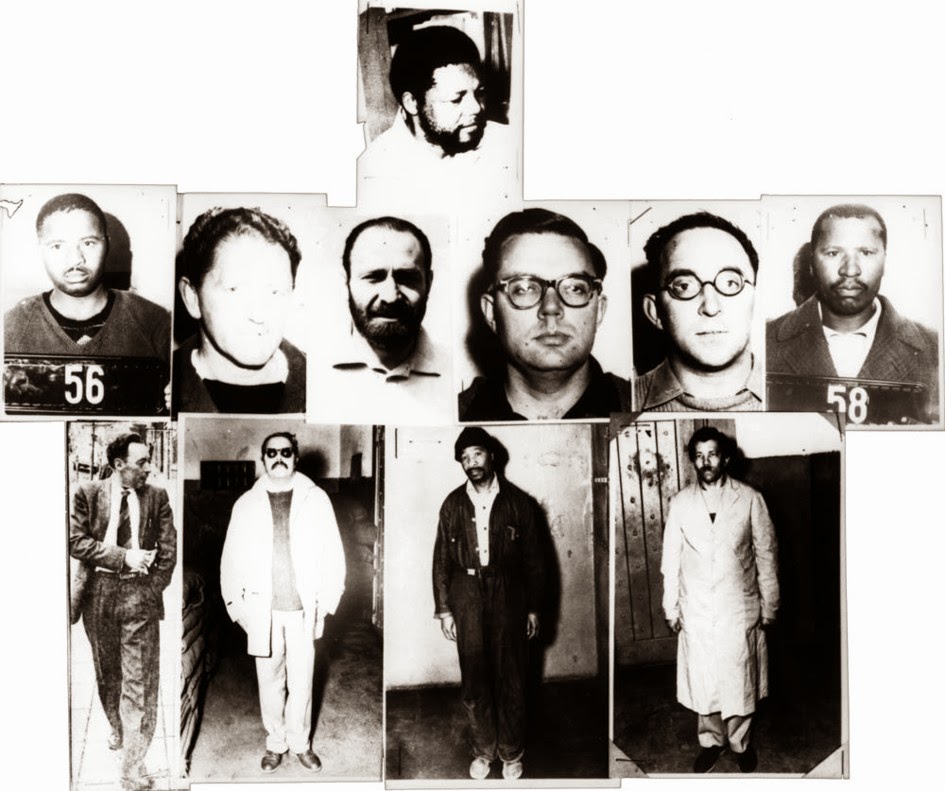
Mandela was part of a radical anti-colonial movement.
Pictured are heroes of the movement at the
Riviona trials.
Revisionism isn’t an event. It’s a process. A sustained exercise in narrative-building. We’ve seen it every hour since the 6th of December when Nelson Mandela died. Mandela’s beliefs and legacy have been white washed. Pun intended. 

In a report on the 7th One News recounted the toolshed version of Mandela’s life. They praised his commitment to reconciliation and added, as a conclusion, that it made him:
“An exception on a continent with a bloody history of long-serving autocrats and violent coups”.

Coming from the perspective that I do, I thought that One News was referring to the “bloody history of long-serving” colonial autocrats and thugs. But I know better than that. The idea that Mandela was above other post-colonial heads of government and state is part of a pattern. The effect is to elevate Mandela above the struggle rather than acknowledge his position as part of the struggle.

But the problem isn’t unique to New Zealand. Nor has it taken the same form every time. The trend has been towards sanctification by reconciliation. Ed Miliband touches on it in the Guardian writing that Mandela’s “spirit of reconciliation” has “been so widely acknowledged in the days since his death”, but he pushes back against that narrative – admittedly in the innocuous way that politicians do – and writes that “the liberation of South Africa was won by a movement”. But the strongest push back has come from people of colour.

Musa Okwonga has written a storming piece: “Mandela will never, ever be your minstrel”. Okwonga launches a fiery critique of the revisionists who will forget Mandela’s “Malcolm X” and only emphasise his Martin Luther King Jnr. 

Yet why does it matter? Mandela was a reconciliator too. It matters because the meaning of Mandela is more than reconciliation, more than forgiveness for the oppressors. Teju Cole captured the absurdity of it all: 

“The prisoner finally dies. The torturers take a moment to praise him (to praise themselves). Then they return to work”.

A lime quarry on "The Island" where Mandela and
others would work in prison. 

In his head, his heart and in his bones Mandela was a humanist. He lived ubuntu. But his humanism didn’t only manifest in his unhuman capacity for forgiveness: it manifested in his anti-colonialism, his anti-imperialism, his commitment to armed resistance. But those aspects of Mandela are at risk of being forgotten. How many media outlets have aired Mandela’s recent views on US and UK foreign policy and the conflict in Iraq and Palestine? Very few. It may seem strange to quote Robert Mugabe, but he captures what Mandela was to people of colour: he was “the great icon of African liberation… [a] freedom fighter”.

But for the white establishment, Mandela represents something different. He represents reconciliation. Writer and historian of colour Jelani Cobb is right in arguing that, for the white establishment: 

“[Mandela’s] capacity to emerge from twenty-seven years in prison without bitterness broadcast the hope that this country’s own racial trespasses might be forgiven”. 

Framing Mandela as a figure only of or primarily of forgiveness is self-interested.

The four former colonies of the Anglosphere share a common history with South Africa.  All are former English colonies and have forged their national identities on that basis. And all have committed atrocities against their indigenous and non-white populations. Indeed, de jure apartheid was partly modelled on Jim Crow laws from the United States and the Indian Act from Canada. 

New Zealand took a different trajectory. (Less brutal, thankfully). But it’s still in the white establishment’s interest to highlight, to celebrate and to push upon us their interpretation of Mandela. Highlighting his reconciliatory aspects gives the white establishment hope that Maori might – no, should! – let go of the past and let the status quo remain.

But that misunderstands the meaning of Mandela. He knew reconciliation was a moral response, but more so it was a matter of survival. When Mandela was released from prison he entered a world that was vastly different from the one he left. Neoliberalism was ascendant and the post-colonial project had collapsed in comparator countries. In Zimbabwe capital flight had ruined the economy and incompetent government had destroyed the optimism of liberation. Closer to home the far right had armed itself and the government security apparatus was sowing tensions between the Inkatha Freedom Party and the ANC. Although it would have been just to arrest, prosecute and imprison the criminals of apartheid it would've ended the post-colonial project by civil war. First and foremost, Mandela was a shrewd politician who knew how to achieve what he needed to achieve. 

Mandela the radical on a commerative
Soviet stamp.

So Mandela emerged at that rare moment where “idealism and pragmatism were practically indistinguishable”. The white establishment honours Mandela’s idealism because it dignifies their argument that people of colour should forget history and move on, but people of colour know that Mandela's real idealism was his commitment to the post-colonial movement.

It has to be remembered that Mandela:

“Was always a maverick within the ANC… In the 1940s and 1950s, when the ANC was the preserve of conservative ‘Black Englishmen’, he advocated taking up arms and fomenting insurrection”. 

Mandela sanctioned armed resistance right to the very end of the apartheid regime.

So don’t forget that Mandela was as much Malcolm X as he was Martin Luther King Jnr. Don’t forget that it is self-serving for the white establishment to portray Mandela as a jesus-like fount of forgiveness ready to absolve the oppressors of all crime and retain the status quo. It is true that Mandela was a source of moral authority. But don’t forget that he was more than that. Anti-colonial, anti-imperial, a liberator and a radical. Amandla!

Post script: I wrote this out of frustration. On reflection, it wasn’t the right headspace. But if I had written it in contemplation, in peace, the words wouldn’t have come. I would have liked to have written a tribute rather than a rant. But words are too small for him. The meaning of Mandela goes deeper than words can. 

Dec 5, 2013

The Golliwog is back (and still racist)

The Golliwog in a minstrel show

It's back. Scandal stalks the Golliwog. Its perpetual return is always greeted with a customary defence and the pattern repeats itself every few years. Today it was Sean Plunket's turn on the stump:

If you can't stomach it, the short version is this: a series of justifications are offered including "it is a doll", where’s the "injustice" in a doll and "we" live in a "massively" tolerant and colourblind society.

He might be right on the last point, though. But only if "we" means people of the same race and gender as Plunket. It's not right if "we" means people like Plunket and people on the margins too, the same people that the Golliwog is a caricature of.

The Golliwog’s return isn't about people of colour reappropriating a caricature. It's about white adults reclaiming the racism of their childhood. Yet the primary problem isn’t that some New Zealanders are nostalgic for the racism of yonder, but that a new generation will be brought up on the myth that the Golliwog is a cultural artifact and a childhood tradition. Generations of children have been socialised into race-relations off of the back of the Golliwog. But the reality is that the Golliwog is a form of historical and contemporary trauma.

People who want to revive the Golliwog probably don’t want to perpetuate racism. But the two can’t be divorced. The Golliwog is to playtime what blackface is to performance. They’re caricatures that are interwoven with the violent oppression of people of colour. The Golliwog was used to reinforce stereotypes about black appearance and character. The wild eyes and hair spoke to black appearance, but the real message was that blacks were wanton. The big lips represented black appearance too, but the outlandish redness reinforced the stereotype that blacks were hyper-sexualised.

The Golliwog is the politics of oppression manifest. Indoctrinating young people with caricatures of people of colour made justifications for and acts of oppression easier. That's partly why it's a false comparison to compare the Golliwog against GI Joe or caricatures of white peoples (like Plunket did). The context above puts a lie to that comparison. But the fact that some people don't get that means the Golliwog isn’t dead and buried yet.

Post script: for context, there's been comment recently on the prominence of Golliwogs in Canterbury. But what sparked the Plunket interview was the sale of Golliwogs in an Invercargill shop. Golliwogs are still sold in other parts of New Zealand too. I know of a children's store in Hamilton that was selling Golliwogs this year (and probably still does). 

Nov 26, 2013

Winning in Te Tai Hauauru


The Maori Party has revealed that six candidates will contest the nomination for Te Tai Hauauru. From the party website:

Hundreds of Maori Party members from throughout the electorate gathered at Whangaehu Marae south of Whanganui yesterday to hear from the six nominees and cast their vote... The nominees are: 
  • Frana Chase; 
  • Rahui Katene; 
  • James Makowharemahihi; 
  • Christopher McKenzie; 
  • Amokura Panoho; 
  • Pakake Winiata.

With the exception of Rahui Katene, these aren't big names. Or put it this way: there isn't a Julian Wilcox. But the party doesn't need a name candidate. Tariana Turia's endorsement and support could be enough to keep the electorate in Maori Party hands. It'd be reckless - and more than unfair - to underestimate the respect and support Tariana has earnt and enjoys. Ken Mair makes an important point, though - "we aren’t looking for a candidate to fill Tariana’s shoes. We are looking for a candidate to carve a new path".

The Maori Party needs to rebuild its identity. The Maori renaissance is over and the post-settlement era is beginning. Tariana and Pita Sharples were - and to some extent still are - central figures from the Maori renaissance. New hands are needed to redevelop what a Maori party looks like in 2013. Being loosely pro-Maori doesn't cut it when three other parties can credibly claim the same rationale (Greens, Labour, Mana).

There's increasing political choice in the Maori electorates. Labour's monopoly is over and the two-way battles of 2005 and 2008 were short lived. Four parties can credibly claim that they're contenders. In an environment where each seat is contested vigorously the Maori Party needs to have something more. New blood is better positioned to redefine the contract between the Maori Party and Maori society than the old hands. That's why the decision in Te Tai Hauauru might be the most important decision the party makes. Good luck to them.

Nov 20, 2013

Living in the age of racism without racists: Andrew Shaw and TVNZ part II

Are the "Yes" voters absolved of their racism because
they didn't intend to be racist? On TVNZ's definition - yes
H/T The Jackalman


The shovels are out at TVNZ and they’re digging deeper and deeper. But the question is who or what do they throw in the hole? The defendant Andrew Shaw, the spokesperson Megan Richards or TVNZ’s conscience and credibility? Pacific Eye Witness reports:

A TVNZ Spokesperson says they are horrified that people have interpreted what Andrew Shaw said to be “taken to mean something that was never intended – that’s why Andrew has apologised to anyone who may have been offended either at the event or after.”

Regan Cunliffe is right: how can you be “horrified that a joke about race was interpreted as being racist”? The answer is easy, but hard to swallow. We live in an age of “racism without racists”.

There’s a sting in being labelled a racist. New Zealanders want to avoid that. But too many don’t want to change their behaviour. Instead a culture of excuse making has developed and TVNZ is perpetuating it.

It goes like this: there are no racists because intent is a safe word. But if that's accepted - and it shouldn't be - then suddenly the struggle for equal rights isn’t about effects, but the intent of the abuser and, you know, 'why can’t we sort this out over a beer because you might be a reverse racist for accusing me of being a racist'. 

But no. Just no. Intent is never the full story. Intent doesn't define what racial bigotry is. Intent doesn’t absolve racial bigotry itself. And when that racial bigotry goes unchecked it helps reinforce racial oppression. 

Intent doesn't matter when a person actively discriminates against Polynesians. And that's what Shaw was doing - actively perpetuating Polynesian stereotypes. There's a history of bigotry against Polynesians - especially Polynesian immigrants - that Shaw is now a part of. 

New Zealanders are desensitised to racism against Maori and against other Polynesians. It’s encoded in our colonial memory and it holds us back. And it’s going to keep holding us back until we get over intent as a barometer of racism. Because there can be no such thing as racism without racists.

Post script: is anyone else unhappy with the silence over this? I mean, Whaleoil is pushing this issue harder than many on the left or in the media. Politicians have weighed in – h/t Sua Sio, but other than that the silence continues. And is anyone else utterly, utterly fatigued with people getting away with bigotry and casual racism? I am. Lastly, here's something of a backgrounder on racism without racists.

Nov 18, 2013

Taking the piss at TVNZ: why Andrew Shaw makes combating racism harder


That's audio from Andrew Shaw - TVNZ's general manager of commissioning, production and acquisitions. In front of an audience of 1000 Shaw "joked" that Auckland is a shithole and Wellington and Christchurch don't get enough "Polynesians".

When Throng revealed the comments and Whaleoil and others publicised them, TVNZ responded:

"We've spoken to many people who attended last night and the feedback has been overwhelmingly positive, and for many, Andrew's presentation was a highlight of the evening. There was no indication anyone was offended and the subsequent questions [yesterday] came as a surprise."

Which misses the point. Completely. It continues:

"Andrew had no intention to cause offence and unreservedly apologises to anyone who may have been offended at the event or subsequently."

I can't put it better than Ta-Nehisi Coates did when discussing Richard Cohen: "context can not improve this. Context is not a safe word that makes all your other horse-shit statements disappear". It doesn't matter whether Shaw meant to cause offense. It's this sort of casual racism that makes confronting other forms of racism - like institutional racism - more difficult. Accidental racism is still racism and it makes parting the iron curtain between Polynesians and the rest of society more difficult. We're still talking past each other if we think intention absolves racism.

I'm not sure whether Shaw is sorry for saying the "joke" or sorry for getting caught. But what's grating is that TVNZ found the "subsequent questions... a surprise". TVNZ shouldn't have to rely on others to be their conscience. The fact that no one in TVNZ recognised the racism in Shaw's remarks is surprising. Is TVNZ a racist institution if it can't recognise the racism in joking about Polynesians being a problem and a reason Auckland is a shithole?  

And then there are the Polynesians in TVNZ itself. It must be hard knowing that workplace racism still exists. This isn't Rhodesia in the 1970s. And then there's the double standard: Paul Henry lost his job for racism, why not Shaw? I'm sure an argument will be made about degrees of racism. Henry's position was different and his racism was of a different kind (which is true). But is it really appropriate to differentiate between racism in degrees? To me, that makes the job of confronting other forms of racism harder still. 

Nov 16, 2013

It's time to talk about colour: why we have to reject labels like 'white Maori'

Manuera Benjamin Riwai Couch: a former All Black, Minister of Maori Affairs
and the first Maori after the abolition of the half-caste rule to win a "European"
(now called general) electorate. Couch is perhaps the father of the ideologies about
Maori development that run through National's Maori MPs. HT Te Ara.

We hardly talk about skin tone. That’s not because we live in a post-racial society, but because our identity as Maori is grounded in whakapapa. Aesthetics don’t define Maori-ness.

But that doesn’t mean colourism is a non-issue. The reverse is true. Colourism is encoded in our colonial memory and the heady hangover remains.

In New Zealand “half-castes” were privileged over “full-blooded” Maori. But the division between full-bloods and half-castes – or dark skins and lighter skins - wasn’t unique to New Zealand. We inherited it.

In the early days of colonialism Britain would divide its slave labour according to skin tones. In the fields of the American South slave owners would privilege light skinned slaves over dark skinned slaves. In South Africa the difference in skin tone (and other features) determined whether a person was black or coloured. Blacks had to carry dompas, coloureds didn’t. In Australia the Half-Caste Act gave states the power to remove “half-caste” children from Aboriginal care and assimilate them into white society.

Early commentary on half-caste Maori cast them in a positive light. Josiah Firth, an early New Zealand farmer, went as far as to celebrate half-castes. He wrote:

“The Half-Castes of New Zealand are in general a fine type of men and women… They are of fine physique, the women being often very handsome…” 
“I have employed Maori half-castes as stockmen, boatmen, and one, as Captain of a river steamer, and I never had better servants”.

But the full blooded or the dark skinned Maori was a paradox. Writing in the early 1900s a perplexed Professor John Brown tried to get his head around Polynesian beauty standards that didn’t value whiteness:

“The finest type of European faces might… find their match in these islands of the Pacific, [but] these were not the most admired by the dusky races, just as the fair skin that sometimes appears amongst them was not admired”.

In an effort to try and explain why Polynesians beauty standards favoured dark skin and “flat noses” Brown argued that it was a result of conquer and intermarriage by and with Melanians who were “negroid” in appearance.

From the early days of settlement and into the 20th century New Zealand society has tried to classify and understand Maori according to skin colour, blood quantum and – but to a lesser extent – cultural practice (i.e. assimilation). But the most telling factor in whether a Maori was half-caste or, well, just a Maori depended on whiteness.

I hope it’s obvious why this matters: skin tone was and is loaded with social and political assumptions. Today there’s a difference between being labelled a “white Maori” and just “Maori”. They’re categories based on appearance, but the first category carries an unearned privilege over the second. Whiteness means full integration and acceptance. Just being Maori implies browness. There are a set of assumptions attached to being brown. Think of the warrior gene.

In a Euro-centric society whiteness can be monetised. Overseas research has indicated that a relationship exists between skin tone (colourism) and upward mobility. A Brazilian study found that people with lighter skin and mixed ancestry have higher rates of social mobility. Anecdotally, the same could be said about New Zealand. Skin tone can have a tangible effect.

Rejecting this is hard. But it starts with self-identification: owning our own identity and using whakapapa as the true measure of identity. What’s external isn’t important when whakapapa is adopted as the only measure of identity. If we can cut ties with labels like half-caste, white Maori, plastic Maori and the others, then we’re half way there.

But rejecting the assumptions that come with being, say, outwardly white is more difficult. The social assumptions attached to being coloured remain. Every Maori who can pass as white has witnessed the racism that seeps through when people think they’re in safe company. Changing that requires a cultural shift. But that comes later. The first step is for us to reject classifications based on appearance and embrace whakapapa as the true and only measure of identity. Other measures minimise people's identity as Maori. Once we get over the hang over from colour in the 19th and 20th century, then we can take on the rest of society.

Nov 1, 2013

The real impediment to a Mana-Maori merger (and it's not National)

Mana Party President and tino rangatiratanga advocate Annette Sykes


Claire Trevett reports:

The Maori Party and the Mana Party have reached a truce of sorts after a meeting between the parties' hierarchy last night. 

Mana President Annette Sykes met the Maori Party's co-vice president Ken Mair last night and the two parties agreed to work framework setting out areas of policy on which they would work together. That is due to be launched in early 2014 and it likely to include areas such as Maori unemployment, poor housing, and child poverty.

Yesterday I ran through the archives of this blog. I was disappointed with the tone (and some of the substance). It was angry. But it was a reflection of Maori politics at the time.

The seeds of tension emerged in 2008. The Maori Party had traveled the country to secure the membership's consent to a supply and confidence arrangement with National. By most accounts, the party leadership won an overwhelming mandate and there was optimism in most circles. But time eroded the consensus. Difficult policy choices started to build. The party misstepped when it supported the ETS and pressure was applied on its MPs to pull their support for Budget 2010 and the GST rise.

Come 2011 the tensions had swelled and the understanding between the Maori Party's radicals and the conservatives – meaning the idea that a Maori political movement is strongest when its united - came crashing down. The rest is history. Hone Harawira broke away with half of the Maori Party and Mana was born. Political parties reap what they sow.

But a relationship accord between Mana and the Maori Party (hopefully) signals that the tide is going out on that conflict. There’s an increasing acceptance that Maori are better off because of the Maori Party’s relationship with National. It hasn't been progress, but the Maori Party has acted as a buffer against decline.

Yet one impediment remains - and it's not necessarily National. The conflict is between Mana and the Maori Party’s conception of politics. Mana is ideological, but the Maori Party acts as post-ideological.

Working "at the table" is the Maori Party's ideology. Party policy is dictated by what can be achieved at the table and what is necessary to remain at the table. There's a pragmatic logic in that, sure, but the consequence is that Maori politics is confined to what's palatable to the ninth floor. There's also an element of circular reasoning when being at the table is both the means and the end.

So if being at the table is the Maori Party's raison d'être then there's little room for Mana - a party that values external change and leftwing ideologies. After all, Hone Harawira threatened the Maori Party's place at the table and he was removed. 

Yet maybe the Maori Party is on the right side of history. The trajectory of Maori politics hasn’t been towards revolution or wholesale structural change. Leaders of the later stages of the Maori renaissance and now the Maori Party, Iwi Leaders and many others prefer integration into New Zealand power structures. The attraction among battle-weary activists and heroes of the movement is clear. But it’s not an approach that attracts Mana. And that’s the real impediment to a merger – not National.